
Friday, 9 July 2010
Review: The Killer Inside Me
Before watching Michael Winterbottom's latest film, The Killer Inside Me, I'd already heard a lot of hubub about its violent content and especially the domestic abuse that the lead character, played by Casey Affleck, inflicts on the two central female protagonists. I personally don't have a problem with film violence as long as its contextual, for example the sexual violence in The Girl with The Dragon Tattoo was gruesome but it advanced the plot and allowed one of the characters to grow. But in The Killer Inside Me it seems the violence comes ahead of what little plot there is. Affleck's deputy sherrif Lou begins a very violent relationship with a prostitute after he tries to convince her to leave the area, he also is trying to get revenge on Chester Conway, the man who he believed killed his adopted brother. He decides to agree with Joy the prostitute to blackmail Conway's son by having the two engage in a relationship and then inform Chester but Lou double crosses Joy and violently beats her almost to death. He then tries to cover up his tracks by killing more and more people while at the same time a county attorney is trying to get to the truth of the murders.
There's no denying that the acting in The Killer Inside Me, is above par. Casey Affleck is a terrific actor which he proved in The Assassination of Jesse James and here gives a captivating performance, is just a shame that he didn't have much material to work with. Again it is distrubing watching him beat both Jessica Alba (as the prostitute) and Kate Hudson (as his girlfriend) but at the same time both actresses are able to come out of their comfort zones and do something a bit different from the romcom tat they usually star in. For me though the star of the show is Brent Briscoe as the bum who bribes Lou after working out what he's done. At the end of the day though this is a very thinly plotted film in which the women are beaten death while the male deaths are either very quick or seen off-screen. Its a film that goes for shock value over genuine drama and comes off rather tacky, it is a shame because there's a good film in there somewhere but Winterbottom would just rather concentrate on sensationalism than drama.

Review: How To Train Your Dragon
In the past Dreamworks animated films, with the exception of Shrek, havve been seen as poor cousins to their Pixar counterparts. Films like Madagascar, A Shark Tale and Bee Movie were never on the same level as Monsters Inc., Finding Nemo and Wall-E. But finally Dreamworks have upped the ante with How to Train Your Dragon based on the series of books by Cressida Cowell. The film concentrates on Hiccup the son of a great Viking Chief, who works as an apprentice blacksmith but dreams of becoming a great warrior like his father. The viking's are constantly at war with the dragons that are invading their land and Hiccup, along with the other young vikings, starts to learn how to fight them but he discovers that the dragons aren't as evil as he first thought and instead learns to tame them. The vikings are stil unsure of this new found relationship and find out that the Giant Dragon cannot be tamed so Hiccup and his young friends with the help of Toothless the Dragon set about defeating the Giant Dragon once and for all.
The main reason for How I Train Your Dragon's success is its warmth and its sympathetic lead. Indeed Hiccup is a lot more likeable that most of the recent Dreamworks animated heroes, even Shrek is beginning to grate after four films. His wish to please his domineering father and also impress young female warrior-in-the-making Astrid make him feel almost relatable. The film combines this warmth with some incredible animated scenes including Hiccup's first journey on the dragon as well as the final battle. Hiccup is ably voiced by everyman-nerd Jay Baruchel who will be well known to all by the end of the year thanks to upcoming roles in She's Out of My League and The Sorcerer's Apprentice. One problem with this film is that the elder vikings are all Scottish while the younger vikings are all Ameircan but at least this fact means that Gerard Butler and Craig Ferguson are able to lend some gravitas to the senior vikings and Jonah Hill and Christopher 'McLovin' Mintz-Please can provide some comic shtick in the sidekick roles. Another bonus is that this film seems to be free of all the pop-culture references that Dreamworks usually litters its films with.
How to Train Your Dragon is never going to be a classic and probably won't stay in the memory for that long after being viewed but it certainly is an above-average family film that everybody can watch together.
Matt's Big Oscar Challenge Day Fifty-Six: The Doctor Will See You Now
Occasionally I've come across a film that I think is incredibly average and unfortunately1932 nominee Arrowsmith is one of them. In fact only several days after having watched it I'm struggling to remember exactly what happened. The basic plot was about a man, Martin Arrowsmith, who was on his way to being a medical researcher but for some reason decides to impulsively marry a nurse called named Leora. Arrowsmith is forced to open a country practise but yearns to do better work and is eventually called upon to conduct important research following some impress ive work on cows.After years of neglecting the wife that he originally changed his career to be with, he comes up with some kind of cure for bubonic plague. Then Arrowsmith is covinced by some Swedish bloke that he should go over to some Caribbean island where everybody is dying of the disease and see if his cure works. He is told only to inject half with the cure and let the rest suffer and die. Meanwhile his loving wife has decided to come over to the island where everyone is dying presumably so she can be closer to him to nag him for ignoring her all the time. Blatantly all the people that are given the cure are cured, and there is a good bit of class warfare as all the white people who live on the island obviously get to live. But Arrowsmith has to pay for his experiment as both the Swedish scientist and his wife die before they get back home.
As you can tell by resentment I really didn't enjoy this film. I found dull, meandering and downbeat most of the time. The ending really did nothing for me as I hadn't really invested any time in the characters to speak of. I didn't think Ronald Coleman did very well in the lead role and it certainly didn't suit his everyman hero image that he perfected in Lost Horizon, but then that was made years before. Similarly British actress Helen Hayes was a bit of a wet blanket here whereas she was a lot stronger in the film I'd seen her in previously, A Farewell to Arms. Again I feel Arrowsmith was simply making up the numbers the year that the far superior Grand Hotel won, but Arrowsmith did get another three nominations includng bizzarely one for the incredibly dodgy script thankfully it didn't win any. Although Coleman would redeem himself in the film that I would watch the next day.
 ive work on cows.After years of neglecting the wife that he originally changed his career to be with, he comes up with some kind of cure for bubonic plague. Then Arrowsmith is covinced by some Swedish bloke that he should go over to some Caribbean island where everybody is dying of the disease and see if his cure works. He is told only to inject half with the cure and let the rest suffer and die. Meanwhile his loving wife has decided to come over to the island where everyone is dying presumably so she can be closer to him to nag him for ignoring her all the time. Blatantly all the people that are given the cure are cured, and there is a good bit of class warfare as all the white people who live on the island obviously get to live. But Arrowsmith has to pay for his experiment as both the Swedish scientist and his wife die before they get back home.
As you can tell by resentment I really didn't enjoy this film. I found dull, meandering and downbeat most of the time. The ending really did nothing for me as I hadn't really invested any time in the characters to speak of. I didn't think Ronald Coleman did very well in the lead role and it certainly didn't suit his everyman hero image that he perfected in Lost Horizon, but then that was made years before. Similarly British actress Helen Hayes was a bit of a wet blanket here whereas she was a lot stronger in the film I'd seen her in previously, A Farewell to Arms. Again I feel Arrowsmith was simply making up the numbers the year that the far superior Grand Hotel won, but Arrowsmith did get another three nominations includng bizzarely one for the incredibly dodgy script thankfully it didn't win any. Although Coleman would redeem himself in the film that I would watch the next day.
Monday, 5 July 2010
Matt's Big Oscar Challenge Day Fifty-Four and Fifty-Five: Three Important Men
What do British Prime Minister Benjamin Disraeli, Meixan freedom fighter Pancho Villa and controversial French author Emile Zola have in common? Apart from being men and famous biopics of their exploits all feature in this decade's list.
Kicking off then with Disraeli which features an Oscar Winning Performance from George Arliss as the man himself. The film concerns itself with the period in Disraeli's life where he tries to build the British Empire and purchase the Suez Canal, however at the time his rival William Gladstone is big news. Gladston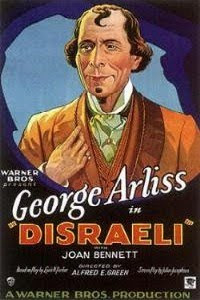 e has a lot more supporters than Disraeli including the head of the Bank of England. As the movie goes on the Russians implant spies in Disraeli's office so they can check on his plans to buy the Canal. As the Suez Canal goes up for sale Disraeli makes a deal with a banker to come up with the funds however the spies inflitrate the banker's firm and declare him bankrupt. Disraeli eventually convinces the head of the Bank of England to give the banker unlimited credit. At the end of the film Disraeli's female companion is awfully ill but he has to leave her in order to see Queen Victoria become Emporess of India, but suddenly his lady friend turns up and the film ends happily. In terms of an early biopic Disraeli was admirable enough. George Arliss' peformance was very worthy and he carried an air of dignity throughout the film. He portrayed a Disraeli who was very wise and thoughtful and also kind to those around him. But at the same time I struggle to remember anyone else in the film apart from the uppity lady spy but that's because it seemed so far fetched. I don't think I can be too critical of this film as it did seem to be quite a large underatking at at time when films were still getting used to sound. However I think if a film made about Disreali's life was made today it would be a lot more professional than this.
Next up is Viva Villa a film about freedom fighter Pancho Villa a Mexican who was fed up with the tyrinical rule of Spanish governers so decided to rise up against them. The film starts with Pancho avenging the death of his father at the hands of one of the generals. Soon Pancho becomes an outlaw attacking willy nilly when and where he sees fit. However his exploits are soon documented b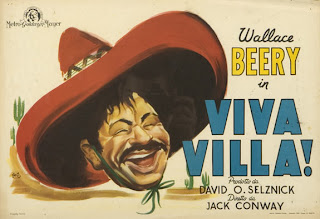 y a newspaper man called Johny who strikes up a sort of friendship with Pancho. The newspaper articles catch the eye of General Madero a visionary who wants to end the Spanish rule and tries to convince Pancho to change his ways and instead of killing people who can't defend themselves to just attack people for further victory. Pancho changes his ways and soon becomes a legitimate general but he gets restless and soon becomes an outlaw once again after he steals. Instead of having him killed Madero simply exiles his friend but when Madero is betrayed and killed by one of his own men, Pancho mounts a massive attack on basically eveyrone until he becomes head honcho, this time though without changing his beliefs. I found Viva Villa to be more of an actioner than a biopic although I'm guessing some of the major plot points are accurate overall the style was incredibly toned towards Villa just killing anyone that got in his path. The storytelling was very sloppy with a lot of the history written up on the screen instead of conveyed through the narrative although the sound and cinematography was all very good and the former even won an Oscar. Overall though I found Wallace Beery's performance tiresome, Beery's rough and ready approach worked in The Champ but here it just seems almost caricaturish. I think if they wanted to do a proper dramatic retelling of Pancho Villa's life then they would've got in someone like Paul Muni.
Speaking of Muni, he's popping up once again in the final of this triple bill of biopics playing Emile Zola in the predictably titled The Life of Emile Zola which won the Best Picture prize at the 1938 ceremony. The film is basically an overview of Zola's career starting with his early days being a poor author living with the Spanish pa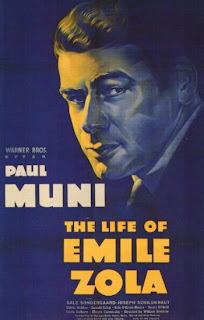 inter Cezzane. Both men then hit it big, with Zola writing Nana the book that launched him and caught the eye of both readers and the authorities who didn't agree with some of his ideals and saw him as being very controversial. After the film deals with Zola's antics it forwards a few years and explores his involvement with Alfred Dreyfus the French Captain who was wrongly accused of supplying militray secrets to the German army. Dreyfus' wife appealed to Zola's better nature and revealed that another major had found evidence of who the real culprit was. Zola then wrote an open-letter in the French newspapers with the phrase - J'Accuse which is famous to this day. The Dreyfus case re-opened with opinion split between those who chose to support the army fully and those who thought they had too much power. Eventually there was not enough evidence to release Dreyfus and Zola was also sentenced to months in prison for libel. Zola absconded to lie-low in London but his time in London is depicted as being a particularly low point, but thankfully a new war comission sought the truth and released Dreyfus which allowed Zola to return to France. However the day of the celebrations of Dreyfus' release, the news of Zola's death from radiation poisioning is displayed on the front of a paper so the ending was bitter-sweet. As always Paul Muni gives a stunning performance, for which he was Oscar nominated but lost, much better than in Louis Pasteur but not as good as in Chain Gang. He is ably supported by Joseph Schildkraut as the sympathetic and doomed Dreyfus and by Gloria Holden as Mrs. Zola. This is certainly a paint-by-numbers biopic which has a lot of gravitas but is pretty slow in some points wanting to paint a good picture of the events but doing so without making a lot of edits where need be. At the end of the day though this is still fairly powerful stuff and some of the trial scenes will stick with you after you've watched the film. It possibly just scraped through with a win that year as the other nominees weren't a particularly inspired bunch and certainly not as much of an Oscar winner as this was. However I suspect had it been another year the film wouldn't have done quite as well as it did.
So I'm done with great men for now however a famous British author will be looked at in some depth in a couple of posts time.
Kicking off then with Disraeli which features an Oscar Winning Performance from George Arliss as the man himself. The film concerns itself with the period in Disraeli's life where he tries to build the British Empire and purchase the Suez Canal, however at the time his rival William Gladstone is big news. Gladston
 e has a lot more supporters than Disraeli including the head of the Bank of England. As the movie goes on the Russians implant spies in Disraeli's office so they can check on his plans to buy the Canal. As the Suez Canal goes up for sale Disraeli makes a deal with a banker to come up with the funds however the spies inflitrate the banker's firm and declare him bankrupt. Disraeli eventually convinces the head of the Bank of England to give the banker unlimited credit. At the end of the film Disraeli's female companion is awfully ill but he has to leave her in order to see Queen Victoria become Emporess of India, but suddenly his lady friend turns up and the film ends happily. In terms of an early biopic Disraeli was admirable enough. George Arliss' peformance was very worthy and he carried an air of dignity throughout the film. He portrayed a Disraeli who was very wise and thoughtful and also kind to those around him. But at the same time I struggle to remember anyone else in the film apart from the uppity lady spy but that's because it seemed so far fetched. I don't think I can be too critical of this film as it did seem to be quite a large underatking at at time when films were still getting used to sound. However I think if a film made about Disreali's life was made today it would be a lot more professional than this.
Next up is Viva Villa a film about freedom fighter Pancho Villa a Mexican who was fed up with the tyrinical rule of Spanish governers so decided to rise up against them. The film starts with Pancho avenging the death of his father at the hands of one of the generals. Soon Pancho becomes an outlaw attacking willy nilly when and where he sees fit. However his exploits are soon documented b
 y a newspaper man called Johny who strikes up a sort of friendship with Pancho. The newspaper articles catch the eye of General Madero a visionary who wants to end the Spanish rule and tries to convince Pancho to change his ways and instead of killing people who can't defend themselves to just attack people for further victory. Pancho changes his ways and soon becomes a legitimate general but he gets restless and soon becomes an outlaw once again after he steals. Instead of having him killed Madero simply exiles his friend but when Madero is betrayed and killed by one of his own men, Pancho mounts a massive attack on basically eveyrone until he becomes head honcho, this time though without changing his beliefs. I found Viva Villa to be more of an actioner than a biopic although I'm guessing some of the major plot points are accurate overall the style was incredibly toned towards Villa just killing anyone that got in his path. The storytelling was very sloppy with a lot of the history written up on the screen instead of conveyed through the narrative although the sound and cinematography was all very good and the former even won an Oscar. Overall though I found Wallace Beery's performance tiresome, Beery's rough and ready approach worked in The Champ but here it just seems almost caricaturish. I think if they wanted to do a proper dramatic retelling of Pancho Villa's life then they would've got in someone like Paul Muni.
Speaking of Muni, he's popping up once again in the final of this triple bill of biopics playing Emile Zola in the predictably titled The Life of Emile Zola which won the Best Picture prize at the 1938 ceremony. The film is basically an overview of Zola's career starting with his early days being a poor author living with the Spanish pa
 inter Cezzane. Both men then hit it big, with Zola writing Nana the book that launched him and caught the eye of both readers and the authorities who didn't agree with some of his ideals and saw him as being very controversial. After the film deals with Zola's antics it forwards a few years and explores his involvement with Alfred Dreyfus the French Captain who was wrongly accused of supplying militray secrets to the German army. Dreyfus' wife appealed to Zola's better nature and revealed that another major had found evidence of who the real culprit was. Zola then wrote an open-letter in the French newspapers with the phrase - J'Accuse which is famous to this day. The Dreyfus case re-opened with opinion split between those who chose to support the army fully and those who thought they had too much power. Eventually there was not enough evidence to release Dreyfus and Zola was also sentenced to months in prison for libel. Zola absconded to lie-low in London but his time in London is depicted as being a particularly low point, but thankfully a new war comission sought the truth and released Dreyfus which allowed Zola to return to France. However the day of the celebrations of Dreyfus' release, the news of Zola's death from radiation poisioning is displayed on the front of a paper so the ending was bitter-sweet. As always Paul Muni gives a stunning performance, for which he was Oscar nominated but lost, much better than in Louis Pasteur but not as good as in Chain Gang. He is ably supported by Joseph Schildkraut as the sympathetic and doomed Dreyfus and by Gloria Holden as Mrs. Zola. This is certainly a paint-by-numbers biopic which has a lot of gravitas but is pretty slow in some points wanting to paint a good picture of the events but doing so without making a lot of edits where need be. At the end of the day though this is still fairly powerful stuff and some of the trial scenes will stick with you after you've watched the film. It possibly just scraped through with a win that year as the other nominees weren't a particularly inspired bunch and certainly not as much of an Oscar winner as this was. However I suspect had it been another year the film wouldn't have done quite as well as it did.
So I'm done with great men for now however a famous British author will be looked at in some depth in a couple of posts time.
Matt's Big Oscar Challenge Day Fifty-Three: My Day with Katherine Hepburn
So far I've encountered a lot of the great female icons of the era during this search - Greta Garbo and Joan Crawford in Grant Hotel, Bette Davis in Jezebel, Marlene Dietrich in Shanghai Express and Claudette Colbert in a number of films. However one star has illuded me so far so I decided to watch all three of her nominated films from that decade in one day, that star is Katharine Hepburn.
Although Katharine Hepburn won her first Best Actress Oscar for only her third performance in Morning Glory. The first film that she was in that was nominated for the Best Picture Oscar was George Cukor's adaptation of Little Women that was up for Best Picture at the 1934 ceremony. Most people already know the story of Little Women but if you don't it basically concerns four sisters as they grow up and become women by finding love and independence. In this version it is Hepburn who plays second eldest sister Jo an aspiring playwright who meets the shy Laurie and they begin to fall in love however she rejects h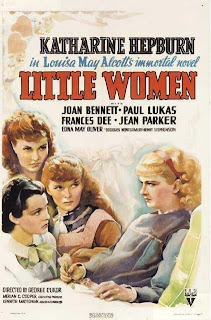 is advances and goes to New York to work as a nanny and to concentrate on her writing. Meanwhile of her other sisters Meg gets married, Amy goes off with her auntie and Beth contracts and eventually dies of Scarlet Fever. The end of the film comes full circle as Beth's death reunites the family and Jo discovers that Amy and Laurie have fallen in love and are about to be married so she accepts the proposal of the German linguist who works with the children that she nannies. Approaching this film I only had a smattering of what the story was about, mainly from that episode of Friends where Rachel gets Joey to read it. At first I found this a little hard to grasp and at times I mixed up the non-Hepburn sisters but once it found its stride and the male characters were introduced I really started to enjoy it. Hepburn's regular strong female stance was on display here as Jo, here she never lets her guard down till the very end and anchors the film from beginning to end however I also thought Jean Parker as Beth was particularly compelling and older character actress Edna May Oliver did a good job of portraying the wealthy but harsh aunt of the girls. Overall this was a good literary adaptation and as so won the Adapted Screenplay Oscar and Cukor was nomianted for his strong direction. This probably would've made it into the list of nominees had it been five strong but it just wasn't as different and challenging as that year's winner Cavalcade.
Two years later at the 1936 awards Hepburn was nominated for her second Best Actress Oscar for her titular performance in the film Alice Adams. Hepburn here would be unsuccesful losing to Bette Davis for the film Dangerous but for me Alice Adams marked a departure for Hepburn in terms of character, Alice displayed little in terms of bravado and instead was quite weak and understated.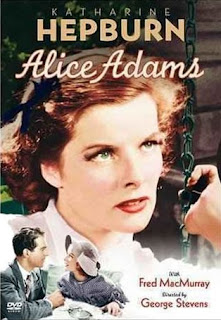 The film is all about class as Alice and her mother hope to rise above their lower-middle class status. The family's father is ill in bed and, even though his job at the glue factory has been left open, they have little money. Alice goes to a party and unable to find a job has to go with her smart alec brother. While there she meets and dances with the dashing Arthur however her lowly class means that she feels she isn't good enough for him. Alice's mother convinces her father to sell an invention for a new type of glue without consulting his business partner and boss essentially meaning he gets called a thief. The finale of the film sees the Adams family host a dinner party with Arthur which is arkward as Alice struggles to make conversation with Arthur while the rest of the family is worried about the consequences of the father's actions. However just when everything seems lost Alice's father and his business partner make up and Alice gets her man, something I found a little far-featched. Despite that finale, Alice Adams was a charming enough picture with another great little performance from Hepburn who is ably supported by Fred MacMurray as Arthur and Frank Albertson as her brother. Again not a film that was ever going to hold a candle to that year's winner Mutiny on The Bounty but again there was nothing particularly wrong with the film.
Hepburn's final Best Picture nominated film came two years later and this time she shared the headline status wtih Ginger Rogers. This film was Stage Door about a group of aspiring actresses who share a boarding house together with Rogers playing the street-smart dancer and Hepburn the haughty rich-girl newbie who puts everyone's noses out of joint. As well as Hepburn and Roger's characters is Kay Hamilton played by Andrea Leeds a young actress who had won rave reviews for her first performance but was struggling to find enough work to pay for rent and meals. Hamilton's chance comes when she aud itions for a show directed by Anthony Powell, a respected director who is pompous and arrogant and refuses to see Hamilton leading to her fainting and Powell getting a tounge-lashing from Hepburn's Terry Randall. However eventually Terry's rich father agrees to finance Powell's show but only if his daughter in the lead role which again means that Randall is an outcast in the boarding house once again. In the end Kay dies and Terry dedicates her performance to her and is eventually forgiven by the rest of the inhabitants. The final scene sees yet another aspiring actress enter the boarding house and life goes on as normal. Out of these three films I think I enjoyed Stage Door the most, the mainly female cast do a great job of everyday banter and you can really believe that they are struggling actresses. Hepburn returns to her strong nature playing the posh girl in a house full of down-to-Earth characters but she really has some good chemistry with Ginger Rogers. Even though Rogers played a small grittier role in 42nd Street this film sees a complete departure from the work she did with Fred Astaire and is great. But it is Andrea Leeds as Kay who was nominated for Supporting Actress that year and that was rightly deserved. Rounding off the cast was Adolphe Menjou again playing a little bit of an unsavoury gentlemen, while some of the smaller parts were taken by actresses who would find fame later on including Lucille Ball, Eve Arden and Ann Miller. Despite this being my favourite of the three films it did the worst at the Box Office and by the end of the 1930s Hepburn along with Ginger Rogers and Fred Astaire were considered Box Office poision and weren't getting the roles that they once got.
However Hepburn would turn that around and still holds the record for the most Best Actress Oscars but most of those would be awarded in the 1950s and 1960s so for now its goodbye to Miss Hepburn.
Although Katharine Hepburn won her first Best Actress Oscar for only her third performance in Morning Glory. The first film that she was in that was nominated for the Best Picture Oscar was George Cukor's adaptation of Little Women that was up for Best Picture at the 1934 ceremony. Most people already know the story of Little Women but if you don't it basically concerns four sisters as they grow up and become women by finding love and independence. In this version it is Hepburn who plays second eldest sister Jo an aspiring playwright who meets the shy Laurie and they begin to fall in love however she rejects h
 is advances and goes to New York to work as a nanny and to concentrate on her writing. Meanwhile of her other sisters Meg gets married, Amy goes off with her auntie and Beth contracts and eventually dies of Scarlet Fever. The end of the film comes full circle as Beth's death reunites the family and Jo discovers that Amy and Laurie have fallen in love and are about to be married so she accepts the proposal of the German linguist who works with the children that she nannies. Approaching this film I only had a smattering of what the story was about, mainly from that episode of Friends where Rachel gets Joey to read it. At first I found this a little hard to grasp and at times I mixed up the non-Hepburn sisters but once it found its stride and the male characters were introduced I really started to enjoy it. Hepburn's regular strong female stance was on display here as Jo, here she never lets her guard down till the very end and anchors the film from beginning to end however I also thought Jean Parker as Beth was particularly compelling and older character actress Edna May Oliver did a good job of portraying the wealthy but harsh aunt of the girls. Overall this was a good literary adaptation and as so won the Adapted Screenplay Oscar and Cukor was nomianted for his strong direction. This probably would've made it into the list of nominees had it been five strong but it just wasn't as different and challenging as that year's winner Cavalcade.
Two years later at the 1936 awards Hepburn was nominated for her second Best Actress Oscar for her titular performance in the film Alice Adams. Hepburn here would be unsuccesful losing to Bette Davis for the film Dangerous but for me Alice Adams marked a departure for Hepburn in terms of character, Alice displayed little in terms of bravado and instead was quite weak and understated.
 The film is all about class as Alice and her mother hope to rise above their lower-middle class status. The family's father is ill in bed and, even though his job at the glue factory has been left open, they have little money. Alice goes to a party and unable to find a job has to go with her smart alec brother. While there she meets and dances with the dashing Arthur however her lowly class means that she feels she isn't good enough for him. Alice's mother convinces her father to sell an invention for a new type of glue without consulting his business partner and boss essentially meaning he gets called a thief. The finale of the film sees the Adams family host a dinner party with Arthur which is arkward as Alice struggles to make conversation with Arthur while the rest of the family is worried about the consequences of the father's actions. However just when everything seems lost Alice's father and his business partner make up and Alice gets her man, something I found a little far-featched. Despite that finale, Alice Adams was a charming enough picture with another great little performance from Hepburn who is ably supported by Fred MacMurray as Arthur and Frank Albertson as her brother. Again not a film that was ever going to hold a candle to that year's winner Mutiny on The Bounty but again there was nothing particularly wrong with the film.
Hepburn's final Best Picture nominated film came two years later and this time she shared the headline status wtih Ginger Rogers. This film was Stage Door about a group of aspiring actresses who share a boarding house together with Rogers playing the street-smart dancer and Hepburn the haughty rich-girl newbie who puts everyone's noses out of joint. As well as Hepburn and Roger's characters is Kay Hamilton played by Andrea Leeds a young actress who had won rave reviews for her first performance but was struggling to find enough work to pay for rent and meals. Hamilton's chance comes when she aud
 itions for a show directed by Anthony Powell, a respected director who is pompous and arrogant and refuses to see Hamilton leading to her fainting and Powell getting a tounge-lashing from Hepburn's Terry Randall. However eventually Terry's rich father agrees to finance Powell's show but only if his daughter in the lead role which again means that Randall is an outcast in the boarding house once again. In the end Kay dies and Terry dedicates her performance to her and is eventually forgiven by the rest of the inhabitants. The final scene sees yet another aspiring actress enter the boarding house and life goes on as normal. Out of these three films I think I enjoyed Stage Door the most, the mainly female cast do a great job of everyday banter and you can really believe that they are struggling actresses. Hepburn returns to her strong nature playing the posh girl in a house full of down-to-Earth characters but she really has some good chemistry with Ginger Rogers. Even though Rogers played a small grittier role in 42nd Street this film sees a complete departure from the work she did with Fred Astaire and is great. But it is Andrea Leeds as Kay who was nominated for Supporting Actress that year and that was rightly deserved. Rounding off the cast was Adolphe Menjou again playing a little bit of an unsavoury gentlemen, while some of the smaller parts were taken by actresses who would find fame later on including Lucille Ball, Eve Arden and Ann Miller. Despite this being my favourite of the three films it did the worst at the Box Office and by the end of the 1930s Hepburn along with Ginger Rogers and Fred Astaire were considered Box Office poision and weren't getting the roles that they once got.
However Hepburn would turn that around and still holds the record for the most Best Actress Oscars but most of those would be awarded in the 1950s and 1960s so for now its goodbye to Miss Hepburn.
Matt's Big Oscar Challenge Day Fifty-One and Fifty-Two: Making a Song and Dance of It
As I'm trying desperately to get through the 1930s as I realise I'm way behind schecdule I'm starting to group films together, the first four films are all musicals or related to musicals in a certain way.
First up another one starring frequent Maurice Chevalier contributer Jeanette MacDonald, who would later get her big break in San Francisco, here she plays the heroine but not exactly the title role in Naughty Marietta. MacDonald's character is in fact Princess Maria who, to escape a marriage to elderly statesman, swaps places with her uncle's servant Marietta and boards a boat bound for New Orleans. The boat is in fact full of women who are a bout to be wives to the men of New Orleans but en route the boat is captured by pirates before the pirates are challenged and defeated by a group of vigilantes lead by Nelson Eddy's Captain Warrington. To avoid being married off Maria/Marietta pretends to be a courtesan and is exiled and moved into a house looked over by Warrington. Soon Warrington and Marietta fall in love but things are complicated when her true identity is revealed. She is then taken back to her own palace and the wedding is to go ahead once again however Warrington dupes the nobility and is able to steal away with Maria. Naughty Marietta is an amiable enough film even though it does feel a bit dated in its portrayal of the sexes. Sure Maria is a pretty strong heroine in that she is able to fool most of the male characters, but at the same time she is defined by her relationships. Essentially the film is part screwball comedy part musical and the songs are always well performed if a little overly-theatrical at times, especially those involving the sailors and the pirates. Nelson Eddy and Jeanette MacDonald make a very believable couple, and have better chemistry than MacDonald ever had with Chevalier. But like with a lot of the musical entries this seems like an odd choice to be an Oscar contender, although it did win an award for its sound direction, it lost out on Best Picture to the far superior Mutiny on The Bounty.
One musical that didn't lose out on Best Picture was The Broadway Melody, which was in fact only the second film in history to win that accolade and the first sound film to do so. The story concerns The Mahoney Sisters Queenie and Harriet the latter of whom goes by Hank for most of the film. Hank also is accompanied by Eddie her romantic interest who soon falls for younger sister Queenie. Both sisters audition together but it is Queenie who the director is interested but she convinces him to take both of them . The rest of the film sees Eddie torn between his commitment to Hank and his burgeoning feelings for Queenie. Queenie meanwhile is courted by the well-off Jock who treats Queenie as just a plaything to pick up and use when he feels like it. Meanwhile during the show Hank feels that Queenie is holding her back and is jealous of the attention she is getting. Eventually Queenie and Eddie realise that they are in love and get married while Hank takes on one of the other dancers and tours The Mahoney Sisters act. For one of the very first talking pictures this was very interesting and was ultimately a combination of involving drama and traditional musical theatre. Some of the combinations feel a little jarring the transposition between some of the sisters more dramatic moments and the comedy lisping uncle doesn't really seem to make sense. But the Best Picture award certainly does with competition like The Hollywood Revue of 1929 and the patchy In Old Arizona, the all talking, all singing, all dancing Broadway Melody shed a light on the harsher elements of showbusiness.
As did one of the nominees for the Best Picture prize in 1934, that being 42nd Street. This film sees several different plot strands colliding. The first one involves Dorothy Brock, a star whose Sugar Daddy is financing a production of the show Pretty Lady, however Brock's real love is her old vaudeville partner Pat. The second story follows Julian Marsh, an extremly talented but harsh director whose manner has meant he has no friends, he is also dying and h as lost a lot of money in the Wall Street Crash. The third and final strand looks at the fortunes of Peggy Sawyer a newcomer to Broadway who is cast in the show and after being teased initially by the other chorus girls soon becomes one of them. As the plot goes on Brock's Sugar Daddy learns of her infedility and goes to confront her and she ends up spraining her ankle. Peggy eventually steps into the breach and one of the film's best sequences sees Peggy being trained by Marsh and later comoforted by Dorothy. The last twenty minutes or so of the film is completely song and dance as three Busby Berkley numbers are played back to back among them the film's title track as well as Shuffle onto Buffalo and I'm Young and Healthy. The final scene sees Marsh leave the theatre with a smile on his face and slump outside on the pavement presumably to die. I have to say it took me a while to get into 42nd Street because of the many characters that we had to follow and some of the quick-talking banter, but once I did get into the action I really enjoyed it. This was mainly due to Warner Baxter's performance as Marsh, he really matured as an actor since his Oscar winning performance in In Old Arizona. Although here he, along with the rest of the cast, failed to get a single nomination and as well as Best Picture the film only recieved one other nomination, in Sound Recording, which is a big shame. I would certainly class 42nd Street as the Best Musical that I have watched to date. And I have to say as well there was a nice little supporting performance from Ginger Rogers which is different from anything I've seen her do with Fred Astaire.
Although to round things off we do have a film featuring Fred and Ginger although the topic matter is a little more racy in 1935 nominee The Gay Divorcee. In the film Fred bizzarely plays an American dancer who journeys to England with a friend where he briefly m eets Ginger's character. She has come with her auntie to arrange a divorce from her boring husband. Her aunt brings her to see a slezy lawyer who just happens to be Fred's friend. They arrange for Ginger to meet up with an Italian gigolo so it seems like she is having an affair and she will be able to get the divorce. However Ginger mistakes Fred for the Italian and ends up going up to her room with him. When the other characters realise the mistake they decide to keep Fred and Ginger locked in the room together and as always they fall in love and dance a bit. As with all their films, Fred and Ginger do have a special kind of chemisty. While this film might not be as famous as Top Hat it still has one iconic sequence which sees the couple dancing to Night and Day on a balcony. This film also has more elements of screwball comedy in it, although some of the comedy does fall flat. The film actually did do prety well at that year's Oscar ceremony picking up an award for Original Song as well as several other nominations for its sound and score. However the coupling of Fred and Ginger in this particular film didn't match up to the coupling of Clark Gable and Claudette Colbert in that year's winning effort It Happened One Night.
First up another one starring frequent Maurice Chevalier contributer Jeanette MacDonald, who would later get her big break in San Francisco, here she plays the heroine but not exactly the title role in Naughty Marietta. MacDonald's character is in fact Princess Maria who, to escape a marriage to elderly statesman, swaps places with her uncle's servant Marietta and boards a boat bound for New Orleans. The boat is in fact full of women who are a
 bout to be wives to the men of New Orleans but en route the boat is captured by pirates before the pirates are challenged and defeated by a group of vigilantes lead by Nelson Eddy's Captain Warrington. To avoid being married off Maria/Marietta pretends to be a courtesan and is exiled and moved into a house looked over by Warrington. Soon Warrington and Marietta fall in love but things are complicated when her true identity is revealed. She is then taken back to her own palace and the wedding is to go ahead once again however Warrington dupes the nobility and is able to steal away with Maria. Naughty Marietta is an amiable enough film even though it does feel a bit dated in its portrayal of the sexes. Sure Maria is a pretty strong heroine in that she is able to fool most of the male characters, but at the same time she is defined by her relationships. Essentially the film is part screwball comedy part musical and the songs are always well performed if a little overly-theatrical at times, especially those involving the sailors and the pirates. Nelson Eddy and Jeanette MacDonald make a very believable couple, and have better chemistry than MacDonald ever had with Chevalier. But like with a lot of the musical entries this seems like an odd choice to be an Oscar contender, although it did win an award for its sound direction, it lost out on Best Picture to the far superior Mutiny on The Bounty.
One musical that didn't lose out on Best Picture was The Broadway Melody, which was in fact only the second film in history to win that accolade and the first sound film to do so. The story concerns The Mahoney Sisters Queenie and Harriet the latter of whom goes by Hank for most of the film. Hank also is accompanied by Eddie her romantic interest who soon falls for younger sister Queenie. Both sisters audition together but it is Queenie who the director is interested but she convinces him to take both of them
 . The rest of the film sees Eddie torn between his commitment to Hank and his burgeoning feelings for Queenie. Queenie meanwhile is courted by the well-off Jock who treats Queenie as just a plaything to pick up and use when he feels like it. Meanwhile during the show Hank feels that Queenie is holding her back and is jealous of the attention she is getting. Eventually Queenie and Eddie realise that they are in love and get married while Hank takes on one of the other dancers and tours The Mahoney Sisters act. For one of the very first talking pictures this was very interesting and was ultimately a combination of involving drama and traditional musical theatre. Some of the combinations feel a little jarring the transposition between some of the sisters more dramatic moments and the comedy lisping uncle doesn't really seem to make sense. But the Best Picture award certainly does with competition like The Hollywood Revue of 1929 and the patchy In Old Arizona, the all talking, all singing, all dancing Broadway Melody shed a light on the harsher elements of showbusiness.
As did one of the nominees for the Best Picture prize in 1934, that being 42nd Street. This film sees several different plot strands colliding. The first one involves Dorothy Brock, a star whose Sugar Daddy is financing a production of the show Pretty Lady, however Brock's real love is her old vaudeville partner Pat. The second story follows Julian Marsh, an extremly talented but harsh director whose manner has meant he has no friends, he is also dying and h
 as lost a lot of money in the Wall Street Crash. The third and final strand looks at the fortunes of Peggy Sawyer a newcomer to Broadway who is cast in the show and after being teased initially by the other chorus girls soon becomes one of them. As the plot goes on Brock's Sugar Daddy learns of her infedility and goes to confront her and she ends up spraining her ankle. Peggy eventually steps into the breach and one of the film's best sequences sees Peggy being trained by Marsh and later comoforted by Dorothy. The last twenty minutes or so of the film is completely song and dance as three Busby Berkley numbers are played back to back among them the film's title track as well as Shuffle onto Buffalo and I'm Young and Healthy. The final scene sees Marsh leave the theatre with a smile on his face and slump outside on the pavement presumably to die. I have to say it took me a while to get into 42nd Street because of the many characters that we had to follow and some of the quick-talking banter, but once I did get into the action I really enjoyed it. This was mainly due to Warner Baxter's performance as Marsh, he really matured as an actor since his Oscar winning performance in In Old Arizona. Although here he, along with the rest of the cast, failed to get a single nomination and as well as Best Picture the film only recieved one other nomination, in Sound Recording, which is a big shame. I would certainly class 42nd Street as the Best Musical that I have watched to date. And I have to say as well there was a nice little supporting performance from Ginger Rogers which is different from anything I've seen her do with Fred Astaire.
Although to round things off we do have a film featuring Fred and Ginger although the topic matter is a little more racy in 1935 nominee The Gay Divorcee. In the film Fred bizzarely plays an American dancer who journeys to England with a friend where he briefly m
 eets Ginger's character. She has come with her auntie to arrange a divorce from her boring husband. Her aunt brings her to see a slezy lawyer who just happens to be Fred's friend. They arrange for Ginger to meet up with an Italian gigolo so it seems like she is having an affair and she will be able to get the divorce. However Ginger mistakes Fred for the Italian and ends up going up to her room with him. When the other characters realise the mistake they decide to keep Fred and Ginger locked in the room together and as always they fall in love and dance a bit. As with all their films, Fred and Ginger do have a special kind of chemisty. While this film might not be as famous as Top Hat it still has one iconic sequence which sees the couple dancing to Night and Day on a balcony. This film also has more elements of screwball comedy in it, although some of the comedy does fall flat. The film actually did do prety well at that year's Oscar ceremony picking up an award for Original Song as well as several other nominations for its sound and score. However the coupling of Fred and Ginger in this particular film didn't match up to the coupling of Clark Gable and Claudette Colbert in that year's winning effort It Happened One Night.
Matt's Big Oscar Challenge Day Fifty: I'm always a sucker for a Bad Girl
More from Frank Borzage with the 1932 nominee Bad Girl, an interesting film in that it doesn't deal with Borzage's regular themes of war and doomed relationships. Instead it follows an almost mundane relationship between a shop girl and a radio repairs man. Initially Dorothy is interested in Eddie as he doesn't seem to be interested in her and makes a bet with her friend that she can bed him, so that's where the title of Bad Girl comes from. Eventually Eddie and Dorothy do fall in love and he proposes marriage but on their wedding day he gets fired and then ai ms to set up his own business but at the same time Dorothy finds out she is pregnant so Eddie can't use the money he'd put away for his new business and instead buys an apartment for them. The story turns again when Dorothy wants to hire a private doctor but Eddie doesn't have the money so begins prize fighting and getting himself knocked out in order to look after his wife eventually begging the doctor to work before he is paid. In the end the doctor does the work for free and Eddie and Dorothy are united with their new baby.
For a film that was released in the first few years of sound, Bad Girl seems extremley talky and many scenes feature two people in a room. This would've seemed quite revoultionary at the time when films were full of big action or large blown romantic tales this is just a simple piece of real life drama. For a film ahead of its time it was rightly given the Best Adapted Screenplay award as well as a second Best Director Oscar for Borzage. Of the cast Sally Ellers probably deserved a Best Actress nod for her portrayal of the multi-layered Dorothy whose character changes drastically as the film continues. James Dunn as the hapless Eddie was also fairly compelling but I don't think it was up to the standard of Best Actor. Overall a competent and original picture but not one that could touch that year's eventual winner - Grand Hotel.
 ms to set up his own business but at the same time Dorothy finds out she is pregnant so Eddie can't use the money he'd put away for his new business and instead buys an apartment for them. The story turns again when Dorothy wants to hire a private doctor but Eddie doesn't have the money so begins prize fighting and getting himself knocked out in order to look after his wife eventually begging the doctor to work before he is paid. In the end the doctor does the work for free and Eddie and Dorothy are united with their new baby.
For a film that was released in the first few years of sound, Bad Girl seems extremley talky and many scenes feature two people in a room. This would've seemed quite revoultionary at the time when films were full of big action or large blown romantic tales this is just a simple piece of real life drama. For a film ahead of its time it was rightly given the Best Adapted Screenplay award as well as a second Best Director Oscar for Borzage. Of the cast Sally Ellers probably deserved a Best Actress nod for her portrayal of the multi-layered Dorothy whose character changes drastically as the film continues. James Dunn as the hapless Eddie was also fairly compelling but I don't think it was up to the standard of Best Actor. Overall a competent and original picture but not one that could touch that year's eventual winner - Grand Hotel.
Subscribe to:
Posts (Atom)